Any support channel that an employer pays for eventually produces a reporting question. What do we get to see? The answers on offer tend to sit at two unhelpful extremes.
At one end, nothing: a service that is a black box, which is hard to justify at renewal and impossible to act on. At the other, too much: dashboards that quietly become a way of reading what individual people said, at which point the channel stops being used and the reporting becomes a record of silence.
The useful thing is the shape, not the content
What an employer can genuinely act on is pattern. How many conversations are happening. What proportion of the workforce has opened the door at all. Which themes are rising — fatigue, workload, money, home life — and whether one of them is moving.
A theme rising three weeks running is actionable: it is a rota conversation in February instead of an absence record in June. Knowing which individual raised it adds nothing to that decision, and costs the thing that produced the signal.
The moment a dashboard can be used to identify a person, the dashboard stops receiving anything worth showing.
Small numbers are where privacy actually breaks
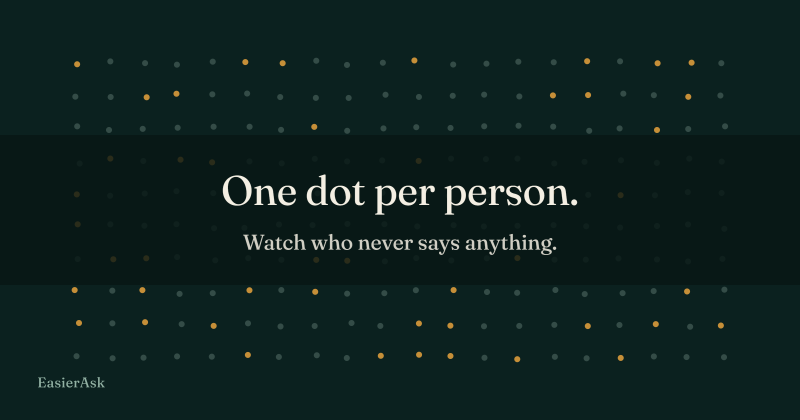
This is the part most often got wrong, and it is not obvious. Aggregate reporting does not protect anybody by itself. On a site of twelve, "one person raised money worries this week" can be as identifying as a name — and if the report also breaks down by site, or by team, or by week, the combinations do the rest.
Anything genuinely built for this applies a minimum count before a figure is shown at all, and suppresses the complementary cells too — because if three of four categories are visible and the total is known, the fourth has been published whether or not it was printed. Weekly volumes get reported in bands rather than exact numbers for the same reason.
It is worth asking a supplier to explain their suppression rules specifically. A vague answer usually means there are none.
What should never appear
- Message content. Not summarised, not excerpted, not "themes extracted from" in a way that reproduces what somebody wrote.
- Anything traceable to a person. Including via combination — site plus shift plus week is often a name.
- Individual counts. "This person has used it four times" is surveillance whatever it is labelled.
What this costs you, honestly
Real limits follow. You will not be able to check whether a specific person is using it. You will not be able to attribute a theme to a team small enough to matter operationally. Some questions a manager reasonably wants answered will not be answerable.
That is the trade, and it is worth stating in the proposal rather than discovering afterwards. The reporting is deliberately less powerful than it could be, because the less powerful version is the one that keeps producing data at all.
Ask what their reporting would show if a single person on a single site raised a single concern. If the answer is anything other than "nothing, until the count is high enough", the privacy model is decorative.